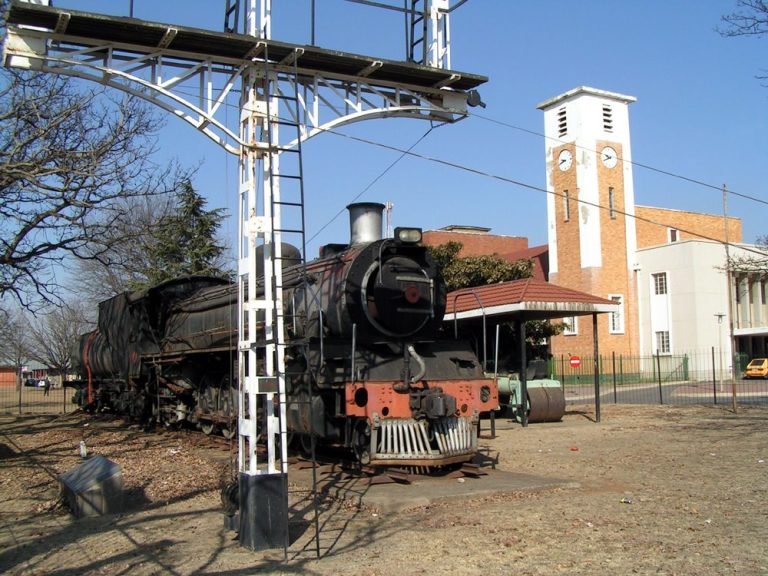
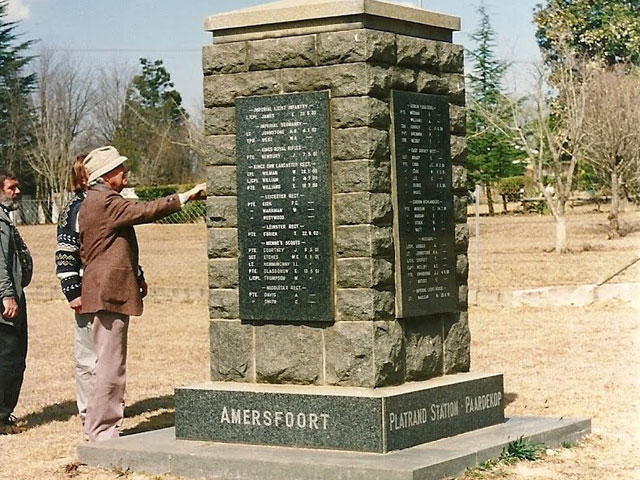
In Volksrust, steam train enthusiasts can find a well-preserved example of a steam locomotive in Market Square, which was renamed Voortrekker Square in 1938. The area also features the Burger Memorial, dedicated to honoring the women and children who perished in the concentration camp, as well as those who fought for the freedom of the Zuid-Afrikaanse Republiek (ZAR).
The 19D locomotive on display in Volksrust is equipped with a “Vanderbilt” tender, characterized by its cylindrical water tank and six-wheeled “Buckeye” bogies. This tender design dates back to 1901 when Cornelius Vanderbilt III—whose great-grandfather founded the New York Central Railroad—developed the cylindrical tender. It quickly gained popularity among American railroads, particularly for oil-burning locomotives. Compared to traditional rectangular tenders, the Vanderbilt design was stronger, lighter, and offered a better fuel-to-surface area ratio. In South Africa, this design was adapted to carry both water and coal for locomotives.
Before World War II, 135 Class 19D locomotives were built by Krupp, Borsig, and Škoda. After the war, an additional 50 Class 19D locomotives were delivered by Robert Stephenson and Hawthorn Ltd. These post-war units were similar to the earlier models but were fitted with vacuum brakes. The final batch of 50 locomotives was built by the North British Locomotive Company in 1949 and came equipped with the Vanderbilt tender, as mentioned earlier.
Renowned for their versatility, Class 19D locomotives served extensively across all South African Railways (SAR) systems and were among the last steam locomotives to be retired from active service.

![{"capture_mode":"AutoModule","faces":[]}](https://www.thezoneresort.co.za/wp-content/uploads/2025/04/unnamed-1.jpg "{\"capture_mode\":\"AutoModule\",\"faces\":[]}")